
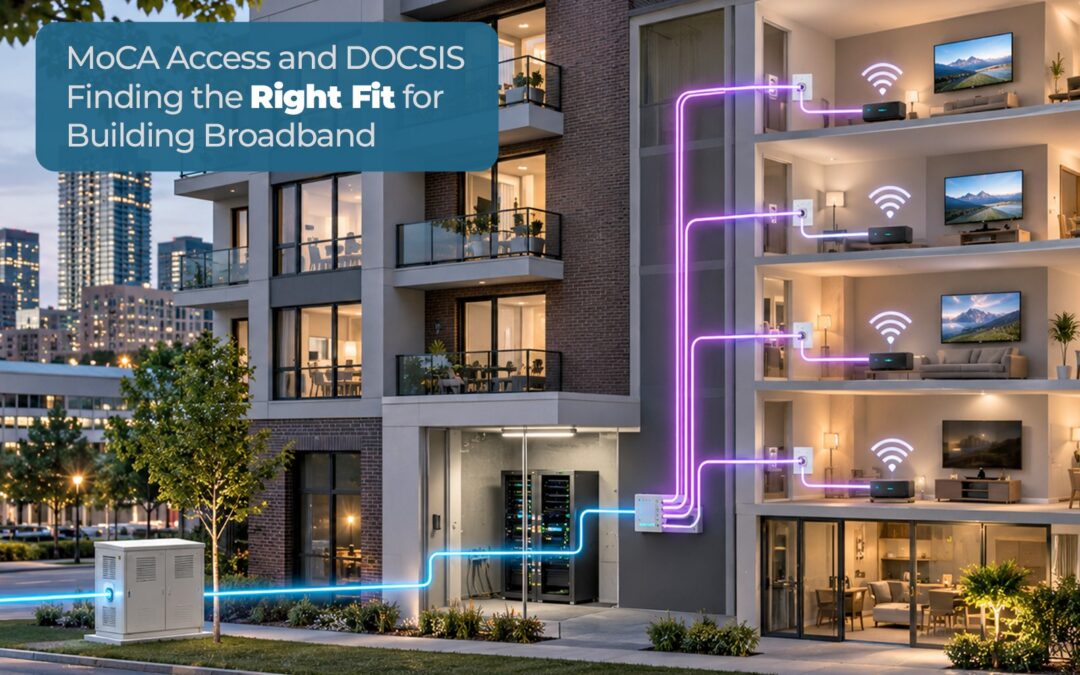
Bringing faster internet to an existing property involves two connected decisions: how broadband reaches the building, and how it reaches the people inside.
For service providers and property owners evaluating coax-based networks, that often raises questions about DOCSIS and MoCA Access. Both technologies carry data over coax, but their role in a project depends on the network architecture, service requirements and infrastructure already in place. Understanding those roles can help you build an upgrade plan that makes better use of your property’s existing cabling.
Start with the network you have
DOCSIS enables broadband delivery over cable operators’ hybrid fiber-coax networks. It remains an evolving technology: CableLabs specifies DOCSIS 4.0 capacity of up to 10 Gbps downstream and 6 Gbps upstream. Those are specification capacities; actual service depends on the deployed network and equipment.
MoCA Access provides another way to extend broadband over coax, particularly within existing buildings. It can carry connectivity from a building’s fiber handoff through coax infrastructure serving apartments or other occupied spaces.
The technologies can complement one another in an appropriately designed network. In other projects, operators may evaluate MoCA Access as an alternative approach to the building distribution network. The useful question is where each technology best supports your service plan.
The building connection is only part of the job
A fast connection at the property entrance creates an opportunity. Delivering that connectivity to individual units requires a practical distribution plan.
In an occupied apartment building or hotel, installing new cable to every destination can involve access appointments, work inside finished spaces and coordination around residents or guests. Existing coax may offer a route that reduces the amount of new cabling required.
MoCA Access is designed to extend fiber broadband using that in-building coax. For properties with suitable infrastructure, it creates a path to higher-speed service while making use of an asset already installed.
Where OptiConn Fi-Speed fits
OptiConn’s Fi-Speed solution uses MoCA Access technology to distribute broadband over existing coax.
The Fi-Speed Micronode supports a 10 Gbps Ethernet/PON uplink and up to four coax outputs, with published throughput of up to 2.5 Gbps on each coax output. OptiConn lists reach of up to 275 meters and support for up to 124 Fi-Speed CNUs across the Micronode. CNUs provide the coax-to-Ethernet connection at the endpoint.
These specifications provide a starting point for network planning. They should be evaluated alongside cable condition, topology, connected endpoints and expected simultaneous demand. A branch’s published capacity should be distinguished from the service speed available to each user.
For a property receiving fiber at a central location, this approach can extend connectivity through suitable coax to individual units. The upgrade can combine a new broadband feed with existing building wiring.
Plan around the property and its users
Before selecting an architecture, work through four questions:
What infrastructure is available? Document the incoming service, coax routes, splitters, amplifiers and endpoints. A site survey helps identify which components can support the proposed design and which require changes.
What service will users need? Evaluate download and upload requirements, busy-hour demand and the number of endpoints sharing capacity. Build the plan around the experience you intend to deliver.
Which services must coexist? Existing television or broadband services affect frequency planning. Coexistence requires a compatible spectrum plan and appropriate network components; sharing coax does not automatically make two systems compatible.
What will deployment and operation involve? Compare equipment, installation labor, access coordination, provisioning and ongoing support. A useful cost assessment accounts for the complete project and its operating requirements.
Put existing coax into your broadband plan
The choice between DOCSIS and MoCA Access starts with understanding the job each technology needs to perform. An operator’s wider access network and a property’s internal distribution network bring different requirements to the design.
For buildings with usable coax, OptiConn Fi-Speed offers a way to extend broadband while reducing reliance on new cable installation. Evaluating that option early can help property owners and service providers develop a more practical upgrade plan.
Planning a broadband upgrade for an existing property?
Explore OptiConn’s Fi-Speed solution and talk with our team about putting your coax infrastructure to work.